what do republicans want to do to social security
August 5, 2021
I of the presidential candidates is a key reason
By Chris Farrell for Next Artery | Photo: Getty Images
I dearest Social Security. Seriously. Social Security was signed into police by President Franklin Roosevelt in 1935 and over fourth dimension has evolved into America's most successful pension and insurance program. Social Security helps keep millions of America'southward elderly out of poverty, too.
Those aren't particularly controversial sentiments, except in bitterly polarized Washington, D.C. Conservatives accept routinely called for cutting back on Social Security's "unaffordable" benefits and "privatizing" the system. Social Security, they say, is "bankrupt" and a "Ponzi scheme." Liberals take staved off Social Security benefits cuts in recent years largely through a defensive strategy of preserving the status quo established by the 1983 National Commission on Social Security Reform.
Merely things are changing — bigtime.
Partial Credit Goes to Donald Trump
Thanks to the political ascent of Donald Trump, the crumbling of the baby blast generation and wage stagnation among those approaching retirement, I believe the signs are unmistakable that the politics of the 81-twelvemonth-old plan are taking a major turn, and for the better.
Every bit I see information technology, the debate in coming years volition shift toward how best to preserve and fifty-fifty increase Social Security benefits, rather than trim them or plow the money over to Wall Street.
Other savvy Social Security analysts agree with me. "I recall that you lot are seeing the cease of the attempt to cutting Social Security," said Brookings Institution demographer William Frey on a panel at the recent Aging in America conference I attended in Washington, D.C. "Nosotros will see increasing pressure to boost Social Security benefits considering of declining individual retirement income."
Voters Oppose Benefits Cuts
American voters desire to see that happen, too.
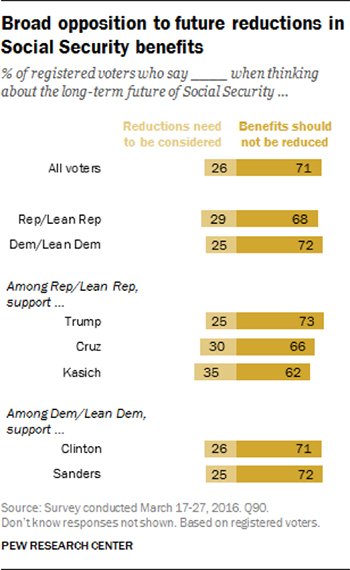
When asked about the long-term time to come of Social Security, 71 percent of registered voters recently surveyed by the Pew Enquiry Center said that benefits shouldn't be reduced in any way. And this has get a bipartisan sentiment. Articulate majorities of Democrats (72 percent) and Republicans (68 percent) opposed Social Security benefit cuts, according to the Pew written report published in March. (Meet the chart for more details.)
Instead, to shore upward Social Security — which is expected to encounter financial difficulties in the 2030s — there'due south solid back up for raising or even eliminating the cap on earnings that are subject to the payroll tax (now $118,500), something both Democratic candidates said they favored in last nighttime'southward debate. A poll by the National Academy of Social Insurance constitute that 71 percentage of Republicans and 92 pct of Democrats agreed that tiptop earners should pay more into Social Security.
Permit's take a step back for a moment to run across how we got to this moment.
A Look Back at the Politics of Social Security
The politics of Social Security has gone through ii major transformations before. The first phase lasted from the early years of the program until the beginning of the 1990s, and featured a consensus about the plan'south legitimacy. Benefits increased incrementally during this period, by and large propelled by robust economic growth after WWII as well as the dominance of middle-right Republicans and centre-left Democrats on Capital letter Hill. Any disputes between conservatives and liberals revolved around the degree and speed of benefits expansion.
Peradventure a 1954 letter from Republican President Dwight Eisenhower to his brother best captures the sentiment of the era:
"Should whatsoever party try to cancel Social Security, unemployment insurance, and eliminate labor laws and farm programs, y'all would not hear of that political party again in our political history. In that location is a tiny splinter group, of class, that believes you can exercise these things. Amid them are H. 50. Hunt (yous possibly know his background), a few other Texas oil millionaires, and an occasional pol or businessman from other areas. Their number is negligible and they are stupid. "
His words read quaint these days, don't they? The Social Security consensus began breaking down during the hard economic years of steep unemployment and high inflation in the '70s and early on '80s, especially during the terms of Jimmy Carter and Ronald Reagan. Conservative critics gained an audition forcefully raising alarms about the system's time to come soundness with the crumbling of the population. A loose coalition of interests ranging from conservative think tanks to fiscal services firms pushed the example for privatizing, or at least partially privatizing, Social Security. "Privatizing" essentially ways transforming Social Security into a private pension plan reminiscent of a 401(k), where savers direct all or part of their Social Security contributions into their own accounts and are responsible for investing the coin. "Wall Street saw privatization as a golden egg," says Lawrence Jacobs, director of the Center for the Study of Politics and Governance at the Hubert H. Humphrey School.
Phase ii in the politics of Social Security dates to the mid-1990s with the rise of Republican House Majority Leader Newt Gingrich and his ideologically driven brand of politics. During President Clinton's and George West. Bush's tenure, the push for privatization and cutting benefits moved from the fringes into the mainstream. Clinton flirted with partial privatization and Bush spent considerable political majuscule in 2005 pushing his own partial privatization plan. Bush'south endeavor failed to gather much popular support, though. Part of the reason is that voters weren't convinced Social Security was in crisis, let alone in danger of imminent plummet, notes William Galston, senior boyfriend at the Brookings Institution in a retrospective analysis. Public doubts about personal accounts intensified the more than people learned of the details, adds Galston.
Nonetheless, conservatives have continued to comprehend this rhetoric. Current House Speaker Paul Ryan has been a long-time proponent of privatizing Social Security in his various budget proposals and one staple of modern bourgeois commentary has been that the swelling ranks of boomers is pushing the U.Due south. toward an inevitable fiscal crisis unless benefits are cut.
Until at present. Although dating transformations is ever a tricky business concern, historians may well highlight the beginning of the tertiary shift in the politics of Social Security to March ten, 2016. During the Republican fence in Miami that nighttime, CNN'south Jake Tapper asked: "What you candidates intend to practice to proceed Social Security going for future generations?" Sen. Marco Rubio focused on raising the retirement age; Sen. Ted Cruz and Gov. John Kasich mentioned private accounts. This was the standard rhetoric of phase two Social Security conservatism.
Then, Donald Trump weighed in, proverb "and it's my absolute intention to go out Social Security the manner it is. Not increment the historic period and to leave it as is." Says Jacobs: "I was watching that debate when he made that statement. The dissimilarity betwixt Trump and everyone else. He has a strong sense of his supporters, Tea Partiers and seniors." (Indeed, in the recent Pew survey, 73 percent of Trump supporters were against reducing Social Security benefits. Similarly, 66 percent of Cruz supporters and 62 percentage of Kasich supporters felt that way equally did 72 percent of Sanders supporters and 71 pct of Clinton supporters.)
The Turn Among Conservative Voters
Well-nigh rank-and-file conservative voters at present support preserving Social Security benefits, and with good reason. The combination of wage stagnation and inadequate retirement savings ways the idea of reducing benefits is anathema to many boomers. To be sure, Cruz, Kasich and another leading Republicans continue to call for individual accounts. Just information technology's hard to believe there is much popular conservative support for turning Social Security money over to Wall Street following the financial crisis of 2008.
Of class, rightwing think tanks volition keep badmouthing Social Security considering they oppose whatever large-scale government programs. Grassroots conservatives aren't buying, though. Tea Party conservatives strongly believe they accept "earned" their Social Security benefits through years of hard piece of work, say Harvard University scholars Vanessa Williamson, Theda Skocpol and John Coggin in their enquiry article, The Tea Party and the Remaking of Republican Conservatism. A majority of Tea Political party supporters surveyed say they likewise prefer new revenues rather than cutting benefits to sustain Social Security over the long haul.
(I imagine Franklin Roosevelt jauntily smiling at the news. To protect the system from being dismantled, it was designed so workers were "earning a correct" rather than qualifying for the "dole," historian W. Andrew Achenbaum has written.)
Democratic White Business firm candidates Hillary Clinton and Sen. Bernie Sanders are campaigning on expanding Social Security benefits. Sanders has called for, amongst other things, raising the minimum benefit and an across-the-board increase for most recipients. Clinton'southward approach is more targeted, aimed largely at boosting benefits for widows and those who've taken time out of the paid labor force to raise a child or intendance for aging parents.
Sanders says he'd pay for the improvements by raising the cap on earnings that can be taxed for Social Security "and then that everyone who makes over $250,000 a twelvemonth pays the same percentage of their income into Social Security as the middle class and working families." Clinton has besides expressed back up for "request the highest-income Americans to pay more, including options to tax some of their income above the current Social Security cap," although she hasn't yet attached any numbers.
However, every bit this testy exchange during last night's Autonomous debate in Brooklyn, N.Y. demonstrates, despite the heated rhetoric both are in basic understanding:
Sanders: Are you lot or are you not supporting legislation to lift the cap on taxable income and expand Social Security for 58 years and increase benefits…
Clinton: I am…
Sanders: — yes or no?
Clinton: I have said yeah, nosotros are going to selection the best way or combination…
The Democratic Party will continue to motion toward a platform of eliminating the cap birthday to keep the trust fund solvent for awhile and to pay for higher promised benefits. For instance, co-ordinate to calculations by Stephen Goss, chief actuary at Social Security, the Sanders approach is sufficient to extend the projected yr of Social Security reserve depletion from its current 2034 to 2074.
Republican legislators are likely to grudgingly have a somewhat higher cap, only only enough to avoid trust fund insolvency by the mid 2030s. Republicans will eventually mute their call for raising Social Security'south Full Retirement Historic period from today'south 66-to-67 to, say, 68 or seventy. Beginning of all, that proposal is a clear benefit cutting that doesn't go over well with grassroots conservatives. More importantly, the enthusiasm for raising the retirement historic period will fade with disturbing evidence that life expectancy is failing among lower income, less educated middle-aged, whites in the U.Southward.
What's more, this disguised do good cut isn't worth pursuing at the moment, since the its impact is surprisingly small on the system's solvency. The conservative legislator mantra will shift from benefit cuts and privatization to preserving the status quo, acting as responsible stewards of existing benefits rather taking the risk of expanding benefits.
Taken altogether, this turn is a healthy political development for all generations.
© Twin Cities Public Boob tube – 2016. All rights reserved.
maxwelltescomirce92.blogspot.com
Source: https://www.kendal.org/news/why-social-security-benefits-wont-be-cut/
0 Response to "what do republicans want to do to social security"
Postar um comentário